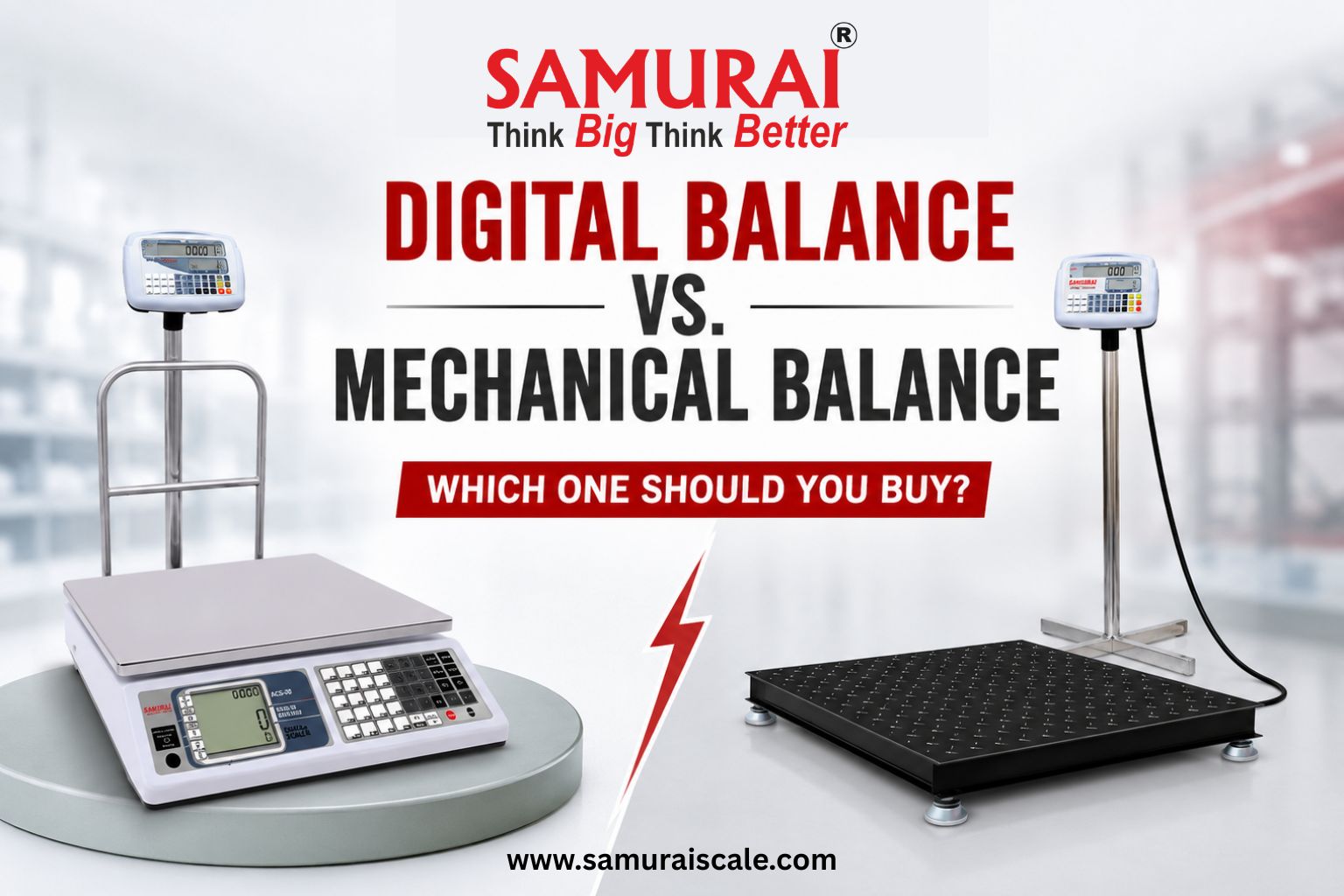
Selecting the appropriate weighing balance is crucial for obtaining accurate measurement in industries, laboratories, retail outlets, warehouses & even homes. As weighing technology progresses, purchasers frequently compare a digital scale to a traditional mechanical scale. Although both help to measure weight, they vary greatly in accuracy, user-friendliness, maintenance & uses.
This guide by Samurai Scale will evaluate both type of weighing balances to help you in making a reliable purchasing choice based on your particular requirements.
What is Digital Balance?
Digital Balance is an electronic weighing device that uses sensors, commonly known as load cells, to measure weight & display the reading digitally on an LCD or LED screen. These balances are designed to deliver highly accurate & consistent measurement with minimal human error.
The modern digital balances often include advanced features such as:
- High-accuracy weight measurement
- Tare (zero) function
- Unit conversion (kg, g, lb, oz)
- Auto calibration
- Overload protection
- Battery & AC power options
- Data connectivity for industrial applications
Digital balances are widely used in laboratories, manufacturing units, pharmacies, jewelry stores, retail outlets, food processing industries & logistics operations where accuracy is critical.
What is Mechanical Balance?
Mechanical Balance is a traditional weighing balance that operates without electricity. It measures weight using springs, levers or counterweight & displays the reading through a dial or pointer.
Mechanical balances are veiled for their simple design & durability. Since they do not rely on batteries or electrical power, they remain functional even in locations with limited power availability.
They are commonly used for:
- Household weighing
- Basic retail applications
- Educational purposes
- Outdoor environments
- Areas where electrical supply is in consistent
Difference Between Digital Balance & Mechanical Balance:
| Feature | Digital Balance | Mechanical Balance |
| Accuracy | High accuracy with minimal error | Moderate accuracy |
| Display | Digital LCD/LED display | Analog dial or pointer |
| Power source | Battery or electricity | No electricity required |
| Speed | Instant weight readings | Slightly slower manual reading |
| Features | Tare, calibration, memory, unit conversion | Basic weight measurement only |
| Maintenance | Requires periodic calibration | Less electronic maintenance |
| Ease of Use | Very user-friendly | Requires manual interpretation |
| Best for | Laboratories, industries, retail, logistics | Home use & basic weighing |
Which One Should You Buy?
The right weighing balance depends on your application, accuracy requirements & budgets.
Choose a Digital Balance if:
- Your require highly accurate measurements
- You work in laboratories or manufacturing industries
- You need advanced weighing features
- You frequently record or analyze weight data
- Speed & efficiency are important for your operations
A digital balance is an excellent investment for business that prioritize productivity, accuracy & operational efficiency.
Choose a Mechanical Balance if:
- You need a simple & affordable weighing solution
- Electricity is not always available
- Basic weight measurement is sufficient
- You prefer equipment with minimal electronic components
While mechanical balances are reliable for general use, they may not meet the accuracy standards required in professional environments.
Best Weighing Balance Manufacturer – Samurai Scale:
Digital and mechanical balances each offer unique benefits, but the optimal selection relies on your specific application. A digital balance is the obvious choice if your priorities are precision, efficiency, and advanced functionality. Mechanical balances continue to be a viable choice for fundamental weighing tasks where ease of use and reliance on no power sources are essential.
For companies looking for dependable, precise, and high-quality weighing devices, Samurai Scale provides reliable weighing solutions that integrate advanced technology with enduring durability, enabling you to obtain accurate measurements with assurance.
Frequently Asked Questions:
- What makes a digital balance more precise than a mechanical balance?
Digital scales utilize electronic load cells to deliver accurate measurements, minimizing the likelihood of manual reading inaccuracies. - Is a digital scale suitable for industrial purposes?
Affirmative. Industrial digital scales are specifically created for manufacturing, warehouses, laboratories, logistics, and commercial weighing purposes. - What factors do I consider when selecting an appropriate weighing balance?
Take into account aspects like needed precision, weight capacity, usage, surroundings, and preferred characteristics prior to choosing a weighing balance.