Choosing the right weighbridge is important for businesses that handle heavy vehicles and bulk materials. A weighbridge, also known as a truck scale or Dharam Kanta, is an industrial weighing system used to measure the total weight of trucks, trailers, and their loads. It is widely used in industries such as construction, mining, agriculture, manufacturing, and logistics.
Weighbridges are available in different designs to suit site conditions, vehicle movement, weighing capacity, and operational requirements. The most common options include pit-mounted, pitless (surface-mounted), portable weighbridges, and axle weighing systems. Understanding the differences between these systems helps businesses select a suitable weighing solution for their operations.
What Is a Weighbridge?
A weighbridge is a heavy-duty weighing platform supported by load cells that measure the load applied by a vehicle. The load cells convert the applied force into electrical signals, which are processed by a digital weighing indicator to display the weight.
Depending on the system, the weight readings can also be recorded through computerised software for reporting, billing, and inventory management.
The design and installation method of a weighbridge influence its space requirements, vehicle access, foundation work, and maintenance needs.
What Are the Different Types of Weighbridges?
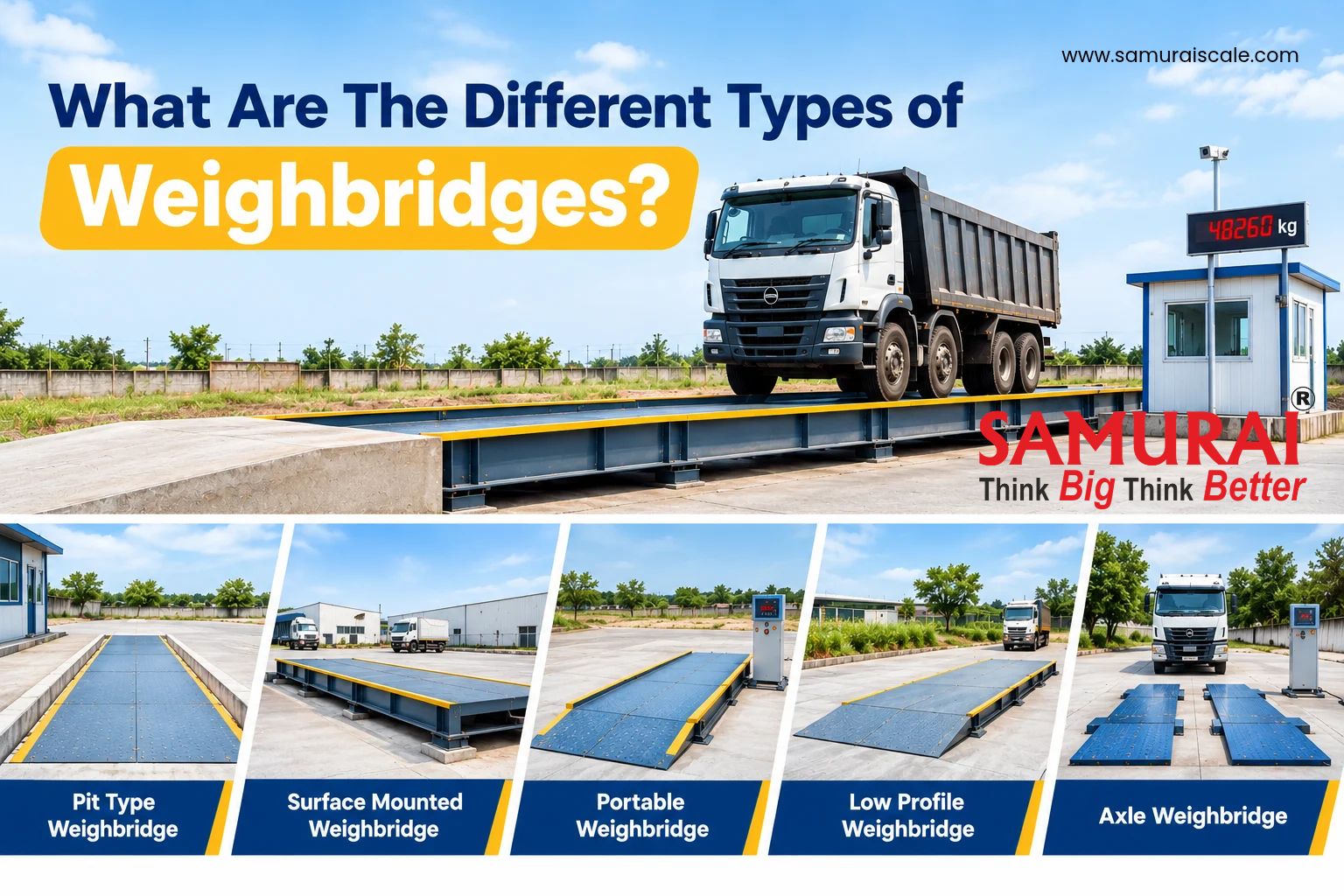
Weighbridges can be classified according to their installation method and weighing application. The following are the main types used in industrial and commercial environments.
1. Pit-Mounted Weighbridge
A pit-mounted weighbridge is installed inside a specially constructed pit so that its weighing platform remains approximately level with the surrounding ground. This arrangement allows vehicles to drive onto the platform without requiring conventional raised approach ramps.
Key features:
- Ground-level vehicle access.
- Suitable for sites where ramp space is limited.
- Requires appropriate excavation, foundation work, and drainage.
- Inspection and maintenance access beneath the platform must be considered during installation.
Applications: Manufacturing plants, industrial facilities, warehouses, and locations where space-efficient vehicle access is required.
A pit-mounted weighbridge can be a suitable choice when the site layout supports underground installation and proper drainage arrangements.
2. Pitless or Surface-Mounted Weighbridge
A pitless weighbridge, commonly called a surface-mounted weighbridge, is installed above ground on a prepared foundation. Approach ramps are generally provided so vehicles can drive onto and off the weighing platform.
Key features:
- Does not require a full-depth weighing pit.
- Usually involves simpler excavation requirements than a pit-mounted design.
- Requires sufficient space for vehicle approach ramps.
- Provides access for inspection and maintenance around the above-ground structure, depending on the design.
Applications: Construction sites, mining operations, logistics centres, factories, and other industrial locations with sufficient space for ramps.
A pitless weighbridge is often preferred when businesses want to avoid pit excavation. However, the foundation, ramp layout, drainage, and vehicle turning space should be assessed before installation.
3. Portable Weighbridge
A portable weighbridge is designed for applications where weighing equipment may need to be relocated or deployed at temporary sites. Its construction, installation requirements, and mobility depend on the specific model.
Key features:
- Can offer flexible installation or relocation options.
- Suitable for certain temporary and remote weighing applications.
- May require a prepared surface and supporting foundation.
- Available capacity and platform dimensions vary by design.
Applications: Temporary construction projects, remote industrial sites, seasonal operations, and locations where permanent installation is not practical.
Before selecting a portable weighbridge, businesses should check its rated capacity, vehicle compatibility, installation procedure, and relocation requirements.
4. Axle Weighing System
An axle weighing system measures the load on individual axles or axle groups instead of necessarily measuring the entire vehicle at once. These systems are useful for checking axle loads and monitoring load distribution.
Key features:
- Measures individual axle or axle-group loads.
- Helps identify uneven load distribution.
- Can support axle-load monitoring and overloading checks.
- May require multiple measurements and a suitable procedure to estimate or calculate total vehicle weight.
Applications: Transport fleets, vehicle inspection facilities, commercial vehicle operations, and locations where axle-load monitoring is important.
Axle weighing systems should not automatically be treated as equivalent to a full-length weighbridge. Their suitability depends on the required measurement, equipment specifications, and applicable regulations.
Pit-Type vs Pitless Weighbridge: Key Differences
Both pit-mounted and pitless weighbridges can provide vehicle weight measurements when correctly designed, installed, and maintained. Their main differences relate to installation, space, and site requirements.
| Feature | Pit-Mounted Weighbridge | Pitless Weighbridge |
|---|---|---|
| Installation | Installed in a constructed pit | Installed above ground |
| Vehicle access | Generally level with the surrounding ground | Usually requires approach ramps |
| Excavation | Requires pit excavation | Generally avoids a full-depth pit |
| Space requirement | Can reduce ramp space requirements | Requires space for ramps |
| Drainage | Pit drainage is an important consideration | Surface water drainage around the foundation and ramps is important |
| Maintenance access | Requires planned access to components inside or beneath the pit | Access depends on the above-ground structure and component layout |
| Suitable locations | Sites with limited ramp space and suitable ground conditions | Sites with enough room for ramps and above-ground installation |
Important: Neither installation type is automatically more accurate or more durable. Accuracy and service life depend on platform design, load cells, foundation quality, installation, calibration, environmental conditions, and maintenance.
How to Choose the Right Type of Weighbridge
Selecting a weighbridge requires more than comparing installation costs. Businesses should evaluate the site, vehicles, weighing requirements, and long-term operating conditions.
1. Consider Available Space
Assess the area available for the weighing platform, vehicle approach, turning movement, and exit. A pit-mounted system may help where ramp space is restricted, while a pitless system generally needs room for ramps.
2. Check Vehicle Size and Weighing Capacity
Choose a platform that accommodates the length and width of the vehicles being weighed. Its rated capacity should be appropriate for the maximum loaded vehicle weight and expected traffic.
3. Evaluate Site and Foundation Conditions
Soil conditions, groundwater, drainage, and civil construction requirements can influence the suitability and cost of different installation types. A site assessment should be completed before finalising the design.
4. Understand Your Weighing Requirements
Determine whether your business needs full-vehicle weighing, axle-load measurement, or a portable arrangement. The correct choice depends on the purpose of weighing and the accuracy and documentation requirements.
5. Check Digital Features and Maintenance Support
Consider whether you need digital indicators, weighing software, transaction reports, vehicle identification, or integration with business systems. Also assess calibration requirements, servicing availability, and spare parts support.
Conclusion
Different types of weighbridges are designed to meet different site conditions and vehicle weighing requirements. Pit-mounted weighbridges provide ground-level access, pitless systems offer above-ground installation, portable models provide flexibility for suitable applications, and axle weighing systems help monitor individual axle loads.
The right choice depends on available space, vehicle dimensions, weighing capacity, installation conditions, and operational needs. Evaluating these factors helps businesses select a practical and reliable weighing system.
Samurai Scale offers weighing solutions for industrial and commercial applications. Explore the weighbridge range from Samurai Scale to find a suitable option for your business requirements.
Frequently Asked Questions
1. What are the main types of weighbridges?
The main types include pit-mounted weighbridges, pitless or surface-mounted weighbridges, and portable weighbridges. Axle weighing systems are another option for measuring individual axle or axle-group loads.
2. What is the difference between pit-type and pitless weighbridges?
A pit-type weighbridge is installed in a pit so its platform is approximately level with the surrounding ground. A pitless weighbridge is installed above ground and generally uses approach ramps.
3. Which weighbridge is suitable for a small industrial site?
The suitable option depends on the available space, vehicle dimensions, foundation conditions, and weighing requirements. A pit-mounted design may help where ramp space is limited, while a pitless design may suit a site with adequate ramp space.
4. Are portable weighbridges suitable for heavy vehicles?
Some portable weighbridges are designed for heavy vehicles, but their capacity and suitability depend on the model. Always verify the rated capacity, installation requirements, and vehicle compatibility before use.
5. Does a pitless weighbridge provide better accuracy than a pit-type weighbridge?
Not necessarily. Both types can provide reliable measurements when properly installed, calibrated, and maintained. Accuracy depends on the overall weighing system rather than the installation type alone.
6. How do I choose the correct weighbridge capacity?
Consider the maximum loaded weight of the vehicles, platform dimensions, expected weighing frequency, and applicable requirements. The selected system should be suitable for the vehicles and loads handled by your business.
Also Read: What is the Purpose of a Weighbridge(Dharam Kanta)?