For business owners, the question of which type of weighing to choose may often arise. Whether to choose an analog scale or a digital one. There are many pros associated with both these scales and each has its own set of benefits. In this blog, we will understand the difference between these scales and compare the properties to finally know which is better to use.
let’s understand how Digital & Analog Weighing Scales work:
Digital Weighing Scale: A Digital Weighing Scale uses chemical cells which contain strain gauges. When the load is placed on the pan, the load cells bend slightly, which changes the resistance of strain gauges. This change is converted into an electrical signal and processed into a digital weight signal, which is then displayed on the screen.
Analog Weighing Scale: The analog weighing scale is divided into two types- spring and beam balance. In spring type, when weight is placed, the spring compresses and this deformation is translated into weight by pointer or dial. In beam balance, the dial is at the center when weight on both beams is equal.
Differences Between Digital & Analog Weighing Scale
| Aspect | Digital Weighing Scale | Analog Weighing Scale |
|---|---|---|
| Accuracy & Precision | Uses strain gauges to provide accurate and precise readings; largely unaffected by vibrations and environmental disturbances. | Relies on needles, dials, and pointers; less accurate and prone to higher deviations. |
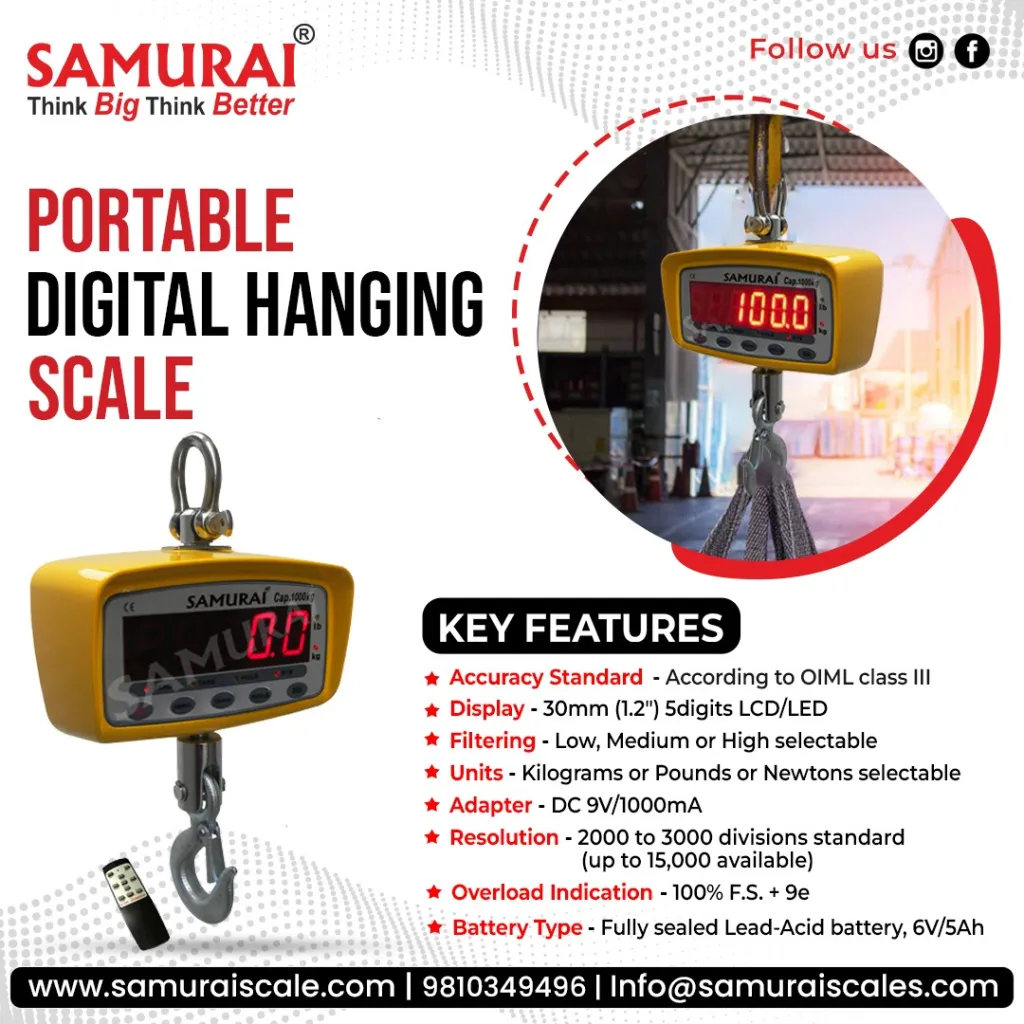
| Heavy-Duty Applications | Suitable for both small and heavy-duty applications; crane-type digital scales can handle loads up to ~30,000 kg. | Generally limited to simple weighing (e.g., grocery stores); not suitable for heavy-duty loads. |
| Ease of Portability | Compact and lightweight, making it easy to transport. | Heavier due to two-pan construction; not easy to carry or move. |
| Usage | Wide range of applications from small to heavy duty; can integrate with software for functions like counting, memory storage, etc. | Limited usage and functionality compared to digital scales. |
| Tare Function | Includes a tare function to automatically subtract container weight and display net weight. | No tare function; container weight must be subtracted manually. |
Conclusion
Our comparative overview shows the digital weighing scale is better than analog Weighing Scales. The accuracy, ease of use, lightweight build, and wide array of features make it useful in diverse applications. It can be integrated with software to work as a counting scale too. So, whether required in retail stores for weighing grocery and household items, or raw materials and components at the industrial level, digital weighing scales are the better option than analog scales.
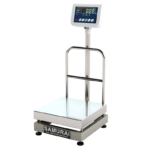
We at Samurai Technoweigh provide a large variety of Digital Weight Machine. From Floor series for medium duty, and crane series for heavy-duty to tabletop scales for retail stores, we have digital weighing scales for all kinds of purposes.