Weight measurement is an essential part of every industry, no matter how small or large scale operations are carried out in it. Accuracy and precision are the key factors why so many industries invest in reliable weighing scales. From logistics management to quality management, these can be found in diverse industries. Crane and hanging scales are the two widely used devices that are used for this purpose. While both work the same way, i.e, suspending the load from a hook to measure the weight, there are key differences between the two. At Samurai Technoweigh, we offer different variants of these scales for specific usage. In this blog, we are going to share the differences and applications of the crane vs hanging scale.
What is Crane Scale & Hanging Scale
When we look at both these scales, we spot similar functions. Both of them are suspended and carry a load beneath them. It saves ground space, unlike a flat platform weighing scale. Gravity exerts a force on the suspended load, giving an accurate measurement.
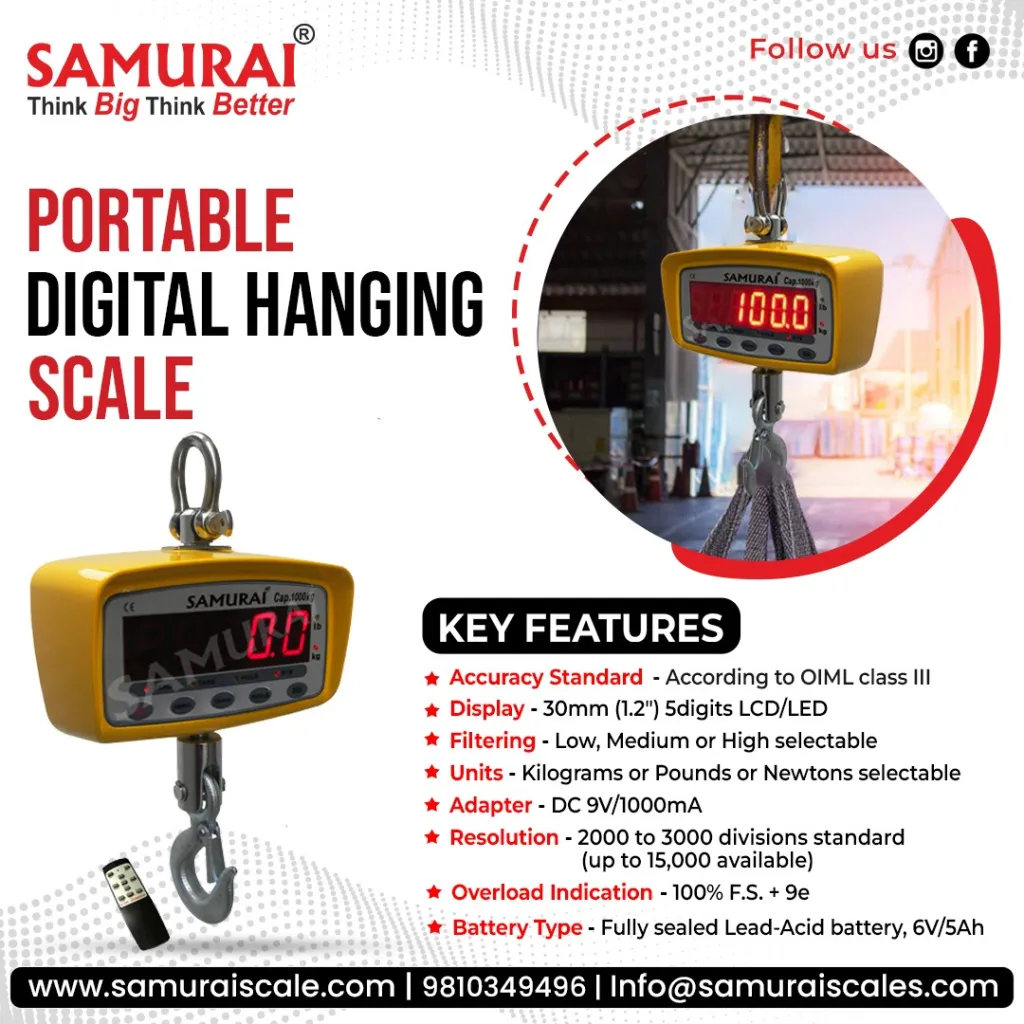
Crane scales are medium to heavy-duty weighing tools used in industrial applications. It is fixed on a crane of hoists, and a heavy load is suspended from these scales. The weight of this scale itself is significantly heavy. These are designed with rugged construction to bear the gigantic loads over a long period.
On the other hand, Hanging scales are light duty weighing scales used for weighing lighter items. These are portable and used for industrial as well as commercial settings. The design of this tool is made with consideration of convenience and longevity.
Differences
- Weight: Crane scales are meant for measuring heavy-duty loads, hence these have a significant weight of itself. Some of its variants can weigh up to 150 kg. Hanging scales are meant for light items; hence, these weigh a maximum of 5 kg.
- Build: Crane scales are subjected to rough usage in the industrial zones. These are built using rugged steel casings that can withstand extreme conditions in the industry. Hanging scales are subject to long term wear but not rough use, so, these are made using aluminium and plastic casings.
- Accuracy: Depending on the load handling capacity, the accuracy changes. For instance, the accuracy of a 20000 kg-capacity crane scale is 10 kg, while that of a 50 kg hanging scale is up to 20 g. As the load increases, the deviation in accuracy also increases.
- Filtering: Crane scales have a filtering option to filter out the swinging or unstable load. Hanging scales have an anti-shake system to balance the vibrations.
When To Use Each
The applications of crane scales are mostly used at the industrial level. These are:
- Metal manufacturing
- Cargo shipping
- Aircraft assembly
- Construction material handling
- Automotive industry
- Warehousing & logistics
The applications of hanging scales are wide because of the countless items being used to weigh using these scales. Some of these are:
- Luggage weighing
- Grocery Stores
- Vegetable Shops
- Poultry shops
- Dairy shops
- Parcel packaging
- Lab experiments
Conclusion
Crane scales and hanging scales are both essential weight measurement tools used in different applications. Modern manufacturers like Samurai Technoweigh provide advanced features like data logging, printing, connection with analysis software and more smart advancements. These can be accessed by remote control and also have Bluetooth connection enabled. Whether you need a hanging scale for a retail store or a crane scale for warehousing purposes, trust us with quality assured tools.